• essentiell - L -

    What happened with the decency in the world?

  • essentiell - L -

    Why have we created this site?

  • essentiell - L -

    The climate change sceptics have a point. Todays global warming doesn't have to be caused by human intervention, it could be a totally natural variation.

  • essentiell - L -

    What could the famous physician Frank Drake's equation from 1961 have to do with todays polarizing debate, climate change and easily offended 7-year olds on world leading positions?

  • essentiell - L -

    Är vi helt dumma i huvudet? - Are we complete morons? - hal nahn albulada' alkamilun? - Sommes-nous des crétins complets? - Sind wir komplette Idioten? - ¿Somos idiotas completos?


Here we have collected a lot of educational material that you are completely free to copy and/or download. Feel free to refer to www.essentiell.ord but it is not a requirement.

LECTURE

Click here to download our lecture which is pedagogically aimed at senior high school age.

CLIMATE ARGUMENTS

Plants love CO2. So how can higher levels be bad? Read more about ill-considered arguments in our compilation.

GLOBAL WARMING?

"Hockey-stick controversy" and "Straw man(ing)". Here we take a deep dive into the major controversies in the climate debate of today.

SCIENCE

Why are many people in today's society openly critical of science and sometimes even on the verge of hatred?


Lecture aimed for an audience at least from senior high school. All in English.

essentiell_slides.pptx essentiell_slides.odp

essentiell.org_slides.pdf


Why can we have a global warming when the coldest temperature ever in history was measured as recently as 2010 and the warmest ever was measured almost 100 years ago?
A compilation of arguments that climate deniers usually advocate in support of their belief that Global Warming is Fake News and not something that either happens or is caused by humans.
We go through their arguments, point by point, and analyze the truth in them and also show the counterarguments of those who consider Global Warming to be a reality as well as essentill.org's own comments regarding the same arguments. What we will see is that all arguments from the Climate Deniers are either True or at least Partially True. The truth in the arguments is, however, true in the same sense as "an apple is a fruit" but that truth does not provide any immediate insight regarding the climate and Global Warming. Follow the link below to our website about this or a pdf file with the same content.
Both are currently a Google-translation of the Swedish versions.

Websida

or

climate_arguments_eng.pdf


We also have two longer sections here under EDU about CLIMATE and SCIENCE. These are identical to the sections with the same names that are under the ABOUT section on the START page. They fit better here under the more educational content but remain on the start page as many readers have reported empty links.

Global warming does not have to be due to human influence at all, but can be the result of completely natural variations. That argument plus the fact that the atmosphere's greenhouse gas content during periods of time when life has existed on Earth has been many times higher than the levels that science warns about today. This is how climate skeptics usually justify why we do not need to worry about a possible warming of our Earth.
The first argument may be true even though almost all serious scientists today believe that the dramatic changes we see in the climate today are entirely due to human influence. The second argument is unequivocally true, the Earth has had a much higher proportion of greenhouse gases in the atmosphere during other geological periods than today.

But why do these facts not matter as arguments?
So, 1/ why does it not matter if it is humans who are the cause of our increasingly high global temperatures and extreme weather and 2/ why is it completely irrelevant that the Earth has previously had much higher levels of greenhouse gases and CO2 than we see today?
1/. It doesn't really take any significant brain exersize to realize that the answer to the question why a car is driving towards a cliff at the moment may seem irrelevant in favor of the perhaps more immediate question - of how to stop the car. Both sides in this controversy agree on an increasing frequency of both extreme weather and a global average temperature.
2/. Even if the levels of CO2 previously have been much higher in the atmosphere, it is on the other hand a rather strenuous effert to conclude that properties and conditions that favor life during one specific geological era on Earth are automatically favorable and good conditions for other life during another era. We even had a hard time formulating that sentence so that it was coherent and understandable, so crazy is the idea and so obvious is it that even if the Earth had higher levels of CO2 and a climate from it, in an earlier period, why would humans today and our global infrastructure benefit from the same climate and CO2 levels?

Such, and not to say ill-considered, reasoning and logical justification are also the gateway to the second longer text section here under EDU - namely the one about science.

Many people believe that "common sense" is an obvious and fully comparable methodology for evaluating facts about our world. This hubris regarding the method's accuracy in reaching correct answers compared to the standard prevailing method - science, touches on previous sections where we think we see that a large part (1⁄2?) of us humans seem particularly inclined to activities that provide quick and easy access to confirmation. Like a baby's pacifier, they cling to social media, especially where one publish everything that tends to provide attention and confirmation. In order to give this, methodology of "common sense" any credibility, one must simultaneously discredit the other methodology, i.e. science.
As an individual craving the confirmation, you therefore have an inherent problem:
The optics of ​​drawing conclusions after a few seconds of inner "compilation" and (rational?) analysis, compared to decades of research of hundreds or probably thousands of researchers' findings and results - actually seems silly to say the least. So as advocates of common-sense-methodology, they really have no choice but to attack and instead hack at and discredit science as a method. And as equally surprising as why overgrown babies like Donald Trump can be elected president, it unfortunately works.
We go through what science is and why it is a superior method to describe our world but also why it seems to work to discredit science and that many prefer their or someone else's second-long inner "compilation" instead.

Global warming(?)

Below is a section about our Climate and a threat to it that is commonly referred to as "Global Warming". That is a sloppy expression, Global Warming is of course not a threat to the climate, it is a potential threat to us humans and the standard of living we are used to. The climate is what it is and due to natural variations both geography- and timely wise, different species evolve and thrive accordingly.


Global warming is not true.

Global warming is true.

Below are various pieces of 'evidence' or comments from Climate Skeptics. That is, those who do not believe that humans affect the climate and that the extreme weather we can see is completely natural changes in the climate if you look at this from a historical perspective. The selection comes from a Google search: "climate skeptics", as well as the first linked or mentioned references from that search (December 2018). In the text, Climate Skeptics, Climate Deniers, or the short version of these, skeptics and deniers, are used completely synonymously.

The Spectator (Conservative, English weekly magazine)

Has called the global climate debate a "... climate change agenda" as a "conspiracy against the poor."

Senator James Inhofe (R)

"With all of the hysteria, all of the fear, all of the phony science, could it be that man-made global warming is the greatest hoax ever perpetrated on the American people?" He continues: "... some parts of the IPCC process resembled a Soviet-style trial, in which the facts are predetermined, and ideological purity trumps technical and scientific rigor."

Donald Trump (R)

"The concept of global warming was created by and for the Chinese in order to make U.S. manufacturing non-competitive."

Lavoisier Group (Australian Association of Business Leaders)

Has commented on the UN's negotiations regarding Global Warming as "...an elaborate conspiracy in which hundreds of climate scientists have twisted their results to support the climate change theory in order to protect their research funding"..

Donald Trump (R)

"It snowed over 4 inches this past weekend in New York City. It is still October. So much for Global Warming."

Wall Street Journal (Independent Conservative)

"Global Warming Models Are Wrong Again"

Forbes (Conservative, Business magazine)

Summary of the scientific internal debate around Global Warming, called "Climategate 2.0" by Forbes::
"(1) prominent scientists central to the global warming debate are taking measures to conceal rather than disseminate underlying data and discussions;
(2) these scientists view global warming as a political "cause" rather than a balanced scientific inquiry and
(3) many of these scientists frankly admit to each other that much of the science is weak and dependent on deliberate manipulation of facts and data."

William M. Gray (Prof. Em. Colorado State Univ.)

"Global warming became a political cause because of the lack of any other enemy following the end of the Cold War..." och "...its purpose (is) to exercise political influence, to try to introduce world government, and to control people". Then adding: "I have a demonic view on this."

Donald Trump (R)

"Just out - the POLAR ICE CAPS are at an all time high, the POLAR BEAR population has never been stronger. Where the hell is global warming?"


Below, climate skeptic and Princeton physicist William Happer explains that CO2 is a completely natural part of the Earth's Biosphere. It has been and always will be. (essentiell.org agrees.)


The so-called Global warming


As you can see, there is a lot of skepticism about what is called "Global Warming".
The skepticism is based on three main objections:

  • The scientific community
    fabricates
    data to provide a type of result that is considered to increase the chance of generating grants and research funding.
  • The scientific community is fabricating data to create panic and thereby favor a political agenda that advocates measures against global warming.
  • The types of extreme weather we see and hear reported about are normal variations if you look at the climate from a historical perspective and have nothing to do with human influence.

We will address the 3 objections to "Global Warming" being something 'made up', but first we will establish two things that are important in this context because there are actually so many who do not believe in the concept of Global Warming:

  • 1/ We agree with those who call themselves Climate Deniers: The current increase in global average temperature may still be a result of the natural variations of the Earth's climate.
  • 2/ What is written here is actually truthful* in an objective sense. The content does not depend on "a position" or that we look at the climate issue from a specified direction of "it depends on how you look at it". Which is why point 1 is included and has the word "may" in it.

* One should be careful not to make statements about absolute and objective truths in a philosophical sense. What is meant here is a 'truth' in the sense that virtually all serious research points to the results we present.

Regarding point 2, even serious media today seem to, some degree, still express that this issue is controversial and that scientists, among themselves, are still debating whether there is something behind the hypothesis that we have Global Warming and that it is caused by humans. This is not the case.
The scientists who reject data that supports the hypothesis that we have Global Warming created by humans are extremely few today and even though, for the sake of scientific rigor, we wrote above that it "may" be a natural variation of the climate, we have long since passed the time when that possibility had any scientific weight. However, it is not impossible, just massively unlikely.

Serious scientists of today tell us that we have already passed the time when we can completely avoid future disasters and we now have a scenario before us where we are discussing measures to reduce the degree of disaster. We will return to this, but it is worth clarifying right now that even if this is a natural global trend, we do not see why it should be an obstacle to trying to reduce a continued increase? The effects that increased warming will cause are just as serious regardless of the
semantics
and if it's a "normal" Global Warming or not.

We return to the heart of the controversy and begin with a familiar dispute between the combatants deniers and proponents and which is a well-known schism in climatology called the "Hockey stick controversy".
If you look at how the global average temperature has increased over the last 1000 years and squeeze these into a graph, the graph looks something like
this
, the x-axis shows the centuries and the y-axis shows the global average temperature measured in degrees Celsius (°C ).

Why the trend is commonly called the Hockey Stick Theory also becomes apparent when you look at a stick
here
.


The origin of the controversy stems primarily from the uncertainty in the measurement method. Some researchers argue, firstly, that the measurement method(s) are too uncertain to be able to estimate temperatures on Earth as far back as 1000 years with an accuracy of parts of a degree (°C), and secondly, that even if the trend is correct, it could very well just be natural variation.

We leave untouched whether the measurement methods can handle a resolution of tenths of a degree. Even if we were to refer to research that says the opposite, this is precisely what the controversy is based on – a different opinion about the validity of that research.
What can be shown however, with a completely adequate resolution, are the carbon dioxide levels in the atmosphere historically. Carbon dioxide (CO2) is a chemical substance that leaves clear traces in sediments and in glaciers that persist for hundreds of thousands of years, which makes an estimate of CO2 levels over millennia very easy to measure. The following image is from NASA (link goes to NASA) and shows exactly how CO2 levels have varied over the last 400,000 years.

That CO2 levels are exceptionally high today and that they also coincide with human industrial development, also appears clearly. But that is not where the controversy lies. As physicist William Happer points out in the YouTube clip above, CO2 levels have been much higher historically, even if that means going back much further than 400,000 years as the diagram shows. And that plants require CO2 to survive. You even increase the amount of CO2 in greenhouses so that they grow better! So then high levels of carbon dioxide must both be better and also be completely natural since we have had much higher levels far back in Earth's history, right? There is an expression in philosophy and rhetoric called "
Straw manning
". The term comes from a rhetorical technique where you establish a position (straw man) of the person you are arguing against that is either not true or at least a position that has nothing to do with the matter and that the opponent does not even have as an argument, and then you argue against that position.
As an overly clear example: Two people argue about whether water is good for humans. Person 1 says, "Humans need water and it is essential for life, otherwise we die". Person 2 then counters with "But how would it work if we drowned the entire earth with water, then we would have to swim to each other...and where would we live?".
Drowning the entire earth in water was probably not what person 1 had in mind and he probably saw in his mind that it is important to get his 2 liters of water from a drinking glass per day. So how absurd person number 2 answers is obvious in this particular case, but it can be significantly more ambiguous than that and difficult to detect and often "straw manning" sounds very logical and consistent as an answer.
To get closer to the rhetoric in this particular text, there is an explicit example that is also included below in the attached pdf file of arguments/counter-arguments between climate deniers and advocates of global warming:

Person 1: "We are in a time when the global average temperature has increased over the last 50 years in a way that is unprecedented in human history!"

Person 2: "Nonsense, in 2017 in Antarctica, the lowest temperature ever recorded on Earth was measured and it started snowing in New York earlier than in 20 years last year!"
What does person 2 do for 'straw-manning' and thus an error in the argumentation?
The answer is given below in the text but for a student it can be a good exercise. The answer can also be seen
here
.

And to align ourselves precisely with the theme that began this part with straw-manning:
Person 1 claims that: "Elevated carbon dioxide levels have a strongly negative effect on the climate (for us humans) as it causes global warming which has a number of consequential effects such as raised sea levels and thus coastlines that risk being moved upwards by several meters. Several cities but also entire countries that are directly at sea level would then be completely submerged. A number of other catastrophic climate consequences such as extreme weathers are also at risk of increasing due to an elevated carbon dioxide level."

Person number 2 then says: "But please, someone, carbon dioxide has been a natural part of the Earth's long history and also significantly higher than now and there have never been any problems before. Plants that we are so dependent on in the form of cereals, rice and feed for our domestic animals that then give us meat and food, would die immediately if it were not for CO2. We would simply die out if we removed carbon dioxide!"

We hope it is clear that this is a straw-manning. Person 2 argues as if:
1/ Person 1 claimed that CO2 is a new gas that did not exist in the atmosphere before humans entered the Earth's history
2/ Person 1 claims that carbon dioxide is so dangerous or unnatural as a gas that we must aim to remove it completely. And...
3/ Person 1 is stating that plants do not need CO2 at all.
That is, Person 2 argues against 'scarecrows' that Person 1 did not even bring up as arguments (but it sounds like it).
None of the proponents of humanity having global warming caused by increased levels of greenhouse gases, of which carbon dioxide is one, claim that plants do not require carbon dioxide. That is high school biology and an argument the proponents do not even consider. No proponent would ever claim that carbon dioxide has not been both a natural and also a vital constituent of our atmosphere for hundreds of millions of years.

The Earth's biosphere has itself regulated CO2 and oxygen levels for millions of years and as we will see in the following text below, with varying success with regard to Global temperature and life in that biosphere. And absolutely, one cannot but claim that during these millions of years it has happened naturally. In the sense that humans have not been involved in influencing the levels of either oxygen or carbon dioxide.

This entire reasoning comes from the only thought that remained after listening to William Happer above: Happer expressed a crystal clear "Straw-manning". That is, those who are proponents of increasing atmospheric CO2 levels => increased global average temperature => global catastrophes of a difficult-to-predict nature, have no doubts whatsoever that plants need carbon dioxide and even less doubts that the earth has previously had even higher levels than today. That is not even the issue according to proponenst of global warming. Who has ever claimed that CO2 is not a natural greenhouse gas and that it is not needed by plants? It has nothing to do with the additional effect that increased CO2 has on the global average temperature and what the increased average temperature then causes.

However, everyone (both deniers and proponents) is on board that CO2 is a so-called greenhouse gas, that is, a gas that affects the global temperature. Other greenhouse gases are, for example, methane (CH4 ), ozone (O3 ) and ordinary water vapor, i.e. H2O. As climate skeptics, however, one can still claim that what we are experiencing now are normal variations. And that is the second question on which the controversy is based.
And there we are happy to agree with the climate skeptics! What we are experiencing now may be normal variations, even though in fact virtually all data indicates that we, humanity, are the causative factor behind increased levels of atmospheric greenhouse gases and thus increased global average temperature.

We are going backwards in Earth's history.

About 55 million years ago, it has been possible to deduce from sediments and the like that the global average temperature on Earth was about 8°C higher than today's just over 14°C. The average temperature was thus an astonishing 22°C! And we as a society hear scientists warn of a 1.5-2°C increase and the catastrophic effects it would have on our environment. So the climate skeptics have a point there, since even a global average temperature of 22°C is thus within the "normal" temperature range that the Earth can have.
If we stop here for a while and recapitulate what determines our climate and what can thus be classified as normal.

The Earth is located at a varying, marginally, but still varying distance from the Sun. The sun also has more or less active periods where it emits varying amounts of radiation, known as solar cycles.
Since the amount of radiation affects the temperature, the composition of the atmosphere through which the radiation must pass to reach the Earth's surface or our oceans must also be taken into account. The composition of the atmosphere plays a role in both directions. It determines how much of the radiation is let in and how much of the radiation that is reflected or "bounces" back is let out. Of course, this is the process that is the whole point behind the linear connection between greenhouse gases/CO2and Global Warming.
Our Earth's axis also varies its tilt towards the Sun in a periodicity of ≈26,000 years and together with the previous three variables, it can also affect how the climate looks both globally and in different places on Earth. In summary, the following...:

  • ☛ the distance to the sun (marginally)
  • ☛ the amount of radiation
  • ☛ tilt of the Earth's axis
  • ☛ atmospheric constituents (such as greenhouse gases)


...are traits that effect the climate.

Then we have natural volcanic activity where volcanic eruptions can also affect our climate. The ash that volcanoes spew out can lie like a carpet over the earth and thus create a colder climate. That aspect can be said to belong to the "components of the atmosphere" but for the sake of clarity and because the "components of the atmosphere" affect the climate in a more continuous way, they are separated. A volcanic eruption in severe cases affects the global temperature for decades, and even if in the situation humanity is in now it would be equal to a civilizational collapse of epic proportions, it does not affect (human) life in a longer perspective than that.

An illustration of the effects of large and frequent volcanic activity occurred during a relatively long period between 850 to 630 million years ago, or the so-called Cryogenic period. During that period we had a global ice age where it is believed that the ice sheets from the poles extended almost all the way to the equator. Calling the Earth a global snowball was not far from the truth.

So we have the previously mentioned 4 plus volcanic activity which gives 5 external variables that affect the climate. All 5 can interact maximally in one direction and create
global snowballs
or maximally to the other hole and create some shape of
global oven
.


If we were to compile the climate deniers' arguments by building on the main arguments above with (climatological) phenomena or attributes of today's climate that speak against a global increase in average temperature, a climate denier's list would look something like this:

  • It is not possible to link the increase in greenhouse gases in the atmosphere to human activity with any significance or certainty.
  • It is not possible to link the increase in greenhouse gases in the atmosphere with any significance or certainty to an increase in global average temperature.
  • There are parts of Antarctica, especially eastern Antarctica, where the ice cover is increasing.
  • The global warming hysteria entails enormous financial research grants, which means that there is a self-fulfilling incentive for researchers to perpetuate the concept of Global Warming (and thereby increase the chances of getting a share of the enormous contribution cake these grants bring with them).
  • It is not possible to link with any significance or certainty examples of extreme weather conditions or conditions such as:

  • -more and stronger hurricanes
    -local heat records
    -melting of the Arctic polar ice cap
    -coral death in the world's oceans
    -Dry seasons
    -thaw of areas of permafrost (i.e. areas where the ground never has time to thaw during a usually short summer)
    -reduction of the number of insects
    -more local tornadoes
    -The Gulf Stream is weaker than it has been in the last 1,000 years
    ...to neither Global Warming nor human activity
  • CO2 is not a dangerous gas, it is completely natural and plants require CO2 otherwise they will die .
  • The warmest year in history was 1934, but no one was talking about global warming then.
  • The predicted rise in sea levels was wrong. The rise was smaller, which shows how unreliable the models are
  • And then the most important general point: Even if the global average temperature were to increase and also be the cause of the extreme weather conditions or states above - it is constitutive and part of completely natural variations in the Earth's climate.
  • And finally: The coldest temperature ever measured in history occurred in 2017

There are a couple more arguments, but we have covered the most important ones.

For a more illuminating overview of the climate deniers' arguments and what is used as a counterargument, you can read it here (for mobile, horizontal mode applies), otherwise the same page is available in a PDF compilation here.

As scientific editors for this site, we have extensive experience in scientific research and know that fabrication of data and research results is extremely unusual, and in this case it would also involve a worldwide conspiracy of researchers who unanimously agree on a platform of results that point towards global warming caused by humans (without it being so). The information logistics that would be required for such a scenario and the immense complexity of measures that would be required to hide that conspiracy, seem so utterly unreasonable to someone who knows how the scientific community works. Just such a filter as what
Peer-review
* entails, makes the conspiracy approach disappear on its absurdity – false or bad research does not pass such a filter and if the opposite were true, that Global Warming is made up, all that is needed is to publish results that show it.
If it were not for the first objection about the unreasonable worldwide complexity of cover-up measures the Peer-review objection would be dismissed by a conspiracy theorist as such a step would of course already be part of the conspiracy. Even the reviewers, peer-reviewers, are part of the conspiracy in that case.

Apart from the conspiracy approach, essentiell.org cannot help but agree with all the other points above. The proponents would do the same but at the same time scratch our heads a little and wonder what the above has to do with anything?

The only thing that the skeptics and the proponents completely agree on regarding the things that have to do with the matter is that the Global average temperature is increasing. If you leave aside how much, how fast and why. Period.

So, what most skeptics can also agree on is that it also looks like a trend. Because even though skeptics can see that it seems to be a trend (that can be reversed ant time), let's just assume for all intents and purposes that it continues to increase. If there are any skeptics reading this, don't get caught up in the 'what's-the-cause-step' and whether it is important to determine the human impact on global warming. It would be like stopping at the edge of a cliff and a collapsed bridge and ignoring all the cars driving past on the bridge and over the edge, and at the same time standing and focusing on what caused the collapse instead of putting up stop signs for the cars. Quite frankly, ignore the cause if it stops you, the edge of a cliff is still an edge of a cliff.
And to counter the counterargument: "- How do you know it's a cliff at all? - The Earth and the Earth's biosphere have withstood much greater temperature variations over millions of years!"

The problem is that even if the trend is classified as a normal variation, seen from a historical perspective, it can have catastrophic consequences for today's man todays hymanity today's civilization. A Stone Age man up untill a man pre-urbanization, was extremely flexible in his way of life and could adjust and migrate even if temperatures could change. Even seen from such a narrow perspective as a couple of decades with global average temperatures varying a couple of degrees within that period, one could parry by simply moving to areas with a better climate.
Regardless of migration routes for the early man-kind, one had one's entire life within a radius of 50 meters. And that radius was his/her life throughout his/her life, even during the migration itself. Meaning that even though entire 'clans' migrated, the nature and life that impacted you was always within a 50m radius even though that 'impact circle' followd the migration. There was nothing outside that circle that mattered. That was as far as one could see with any greater resolution and that was as far as one could shoot an arrow or throw a spear with any greater precision.

As everyone can easily see, that is not the case today. That increase and the effect it would have on global infrastructure and logistics - we are hardly adapted for that. In any way. Our food sources are not within a 50m circle but litterlaly comes from all around the globe that relies on the fact that global logistics function. We would experience systemic collapses that we cannot even imagine. Our lives depend fundamentally on everything that happens within a radius of 6,371,000 meters.
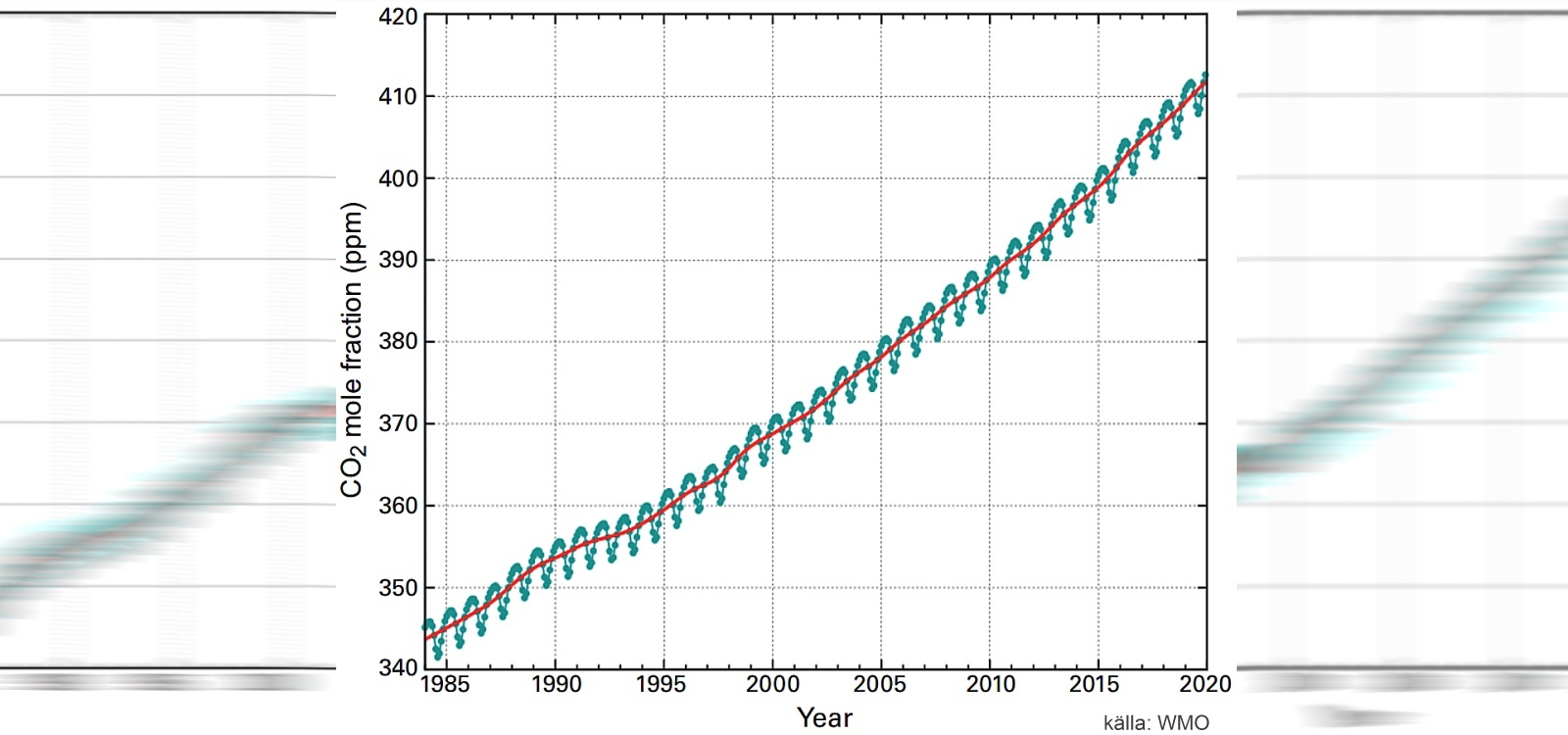
So even if one has to agree with the skeptics that it could be a natural variation, let's agree and quickly look past whether it is natural or not and just look at the consequences of a globally increasing average temperature that increases ≈2.4°C by the year 2050, which it is at the current rate. Reference here (Swedish), based on data from here (English). And since the possible catastrophic consequences will also affect the children and great-grandchildren of you skeptics, let's just assume for the sake of argument that it actually:

  • ...is a trend and that the average temperature will continue to increase.
  • ...may be completely normal variations. There is no controversy there.
  • ...and put behind us whether it's normal or not and whether plants like CO2 . They do. There's no controversy there.

To recap and to make this a bit more difficult, just because the coldest recorded temperature ever was measured locally in Antarctica as recently as 2017 and that plants are digesting carbon dioxide, should Global Warming be on the rise? And we, humanity, can easily carry on as usual because the temperature will start to drop again, right?

We also want to bring skeptics on board with this argument, at least if there is anyone decent reading this and might actually be hesitating. The fact that we can only carry on clashes fundamentally with all the real and data-driven results that point to the fact that even Trump's and Bolsonaro's great-grandchildren (&asympt;2100) risk living in a completely collapsed society where the world's coastal areas have been submerged in rising sea levels and huge agricultural areas are parched and 20 million to 1 billion of the world's population live in starvation conditions as climate refugees, reference here from 'The Intergovernmental Panel on Climate Change', IPCC.
1 billion is of course 'worst-case' but on the other hand 'worst-case' is actually based on the fact that the global average temperature continues to increase at th e same rate it is now. Today 2025, there is no indication that the increase in global temperatues are declining, rather the opposite. We as a global society, as incredible as it may sounds, are actually just driving on as if nothing is wrong.

Not many of the climate commitments we sign internationally are actually implemented. For example, in 1999 the Swedish Parliament adopted 16 environmental and climate goals that were to be met by 2019. 15 of these have either not happened or, even worse, the situation has become more poorly. Reference here from the Swedish Environmental Protection Agency (Naturvårdsverket).
It is still Sweden. The USA and China are even reluctant to enter into any agreements at all.

The real danger lies in so-called 'run-away' effects, i.e. a climate scenario where we have passed the point where international agreements or commitments to reduce the factors that affect a rising global average temperature no longer matter. We could end up in a situation where we decide overnight to live at an emission level equivalent to a Stone Age society, and it wouldn't matter – at all. The temperature would increase and increase and increase to some kind of plateau temperature that in all comparative aspects to today's Western welfare society, would most likely be categorized as anarchy and system collapse.

We have other planets in our solar system where this has happened...in a completely natural way if you will. On Venus it is today ≈450°C on the surface.
The above is hypothetical reasoning, it is in the nature of the question, and of course only possible examples of risks and global conditions but we are not talking about parts of a percent here, but definitely several tens of percentage points - if we continue at the current pace of greenhouse gas emissions.
The comparison with Venus is, however, only an indication of how high the temperature is and that it is due to a 'run-away' effect initiated by Global Warming. Scientists are today largely agreed that the Earth cannot be affected in the same way as Venus' run-away-caused greenhouse conditions are induced by completely different mechanisms.

But if we continue at the current pace of increased greenhouse gases and the rate of Globally increasing average temperatures, we will end up in gradual catastrophes and collapses in ways and measures that are therefore difficult to overview. If anyone thinks that scientists mainly disagree about this, they are WRONG. At the current rate, and there is nothing to indicate a different curve, we are on our way to a 2° increase (around the turn of the year 2038-2039) of the Earth's average temperature compared to pre-industrial times. Under these premises, the only thing people disagree about is, for example, when the Arctic will become ice-free in summer, when the permafrost in the northern hemisphere will begin to melt under a run-away effect, when 100% of all the Earth's coral reefs will die, when southern Europe and large parts of Africa will be classified as unusable desert...etc.
Most agree that we have already passed the threshold for future disasters, we can only regulate the degree of disaster. Some scientists har passerat tiden för att göra något åt över huvud taget. Läs mer here från 'Union of Concerned believe that we have already passed the time to do anything about it at all. Read more here from the 'Union of Concerned Scientists' and here in an article from Science Magazine ™ . A short summary of the effects of current, continued, greenhouse gas emissions to the year &asympt;2100:
(WIKI references here, also with linked material therein.)

Africa:
Hundreds of millions will become "climate refugees" as droughts will hit this continent extra hard. It will simply not be possible to grow anything. Large parts of southern Africa and the Sahel region will become uninhabitable for humans. Very high risk of increased regional armed conflicts if the resources that are depleted due to drought are not used up.

Asia:
When the glaciers in the Himalayas melt, the drainage rivers, Ganges, Brahmaputra, Yangtze, Mekong and Indus, will be hit very hard. Billions of people will become climate refugees and will live on the verge of starvation. Bangladesh risks losing half its land area due to rising sea levels. A relatively moderate increase in the global average temperature of 2°C in this context and as of today means a run-away effect of the thawing of the Siberian permafrost layer. And the effect of this is predicted by many to be a goodbye to the civilization we know today.

Europe:
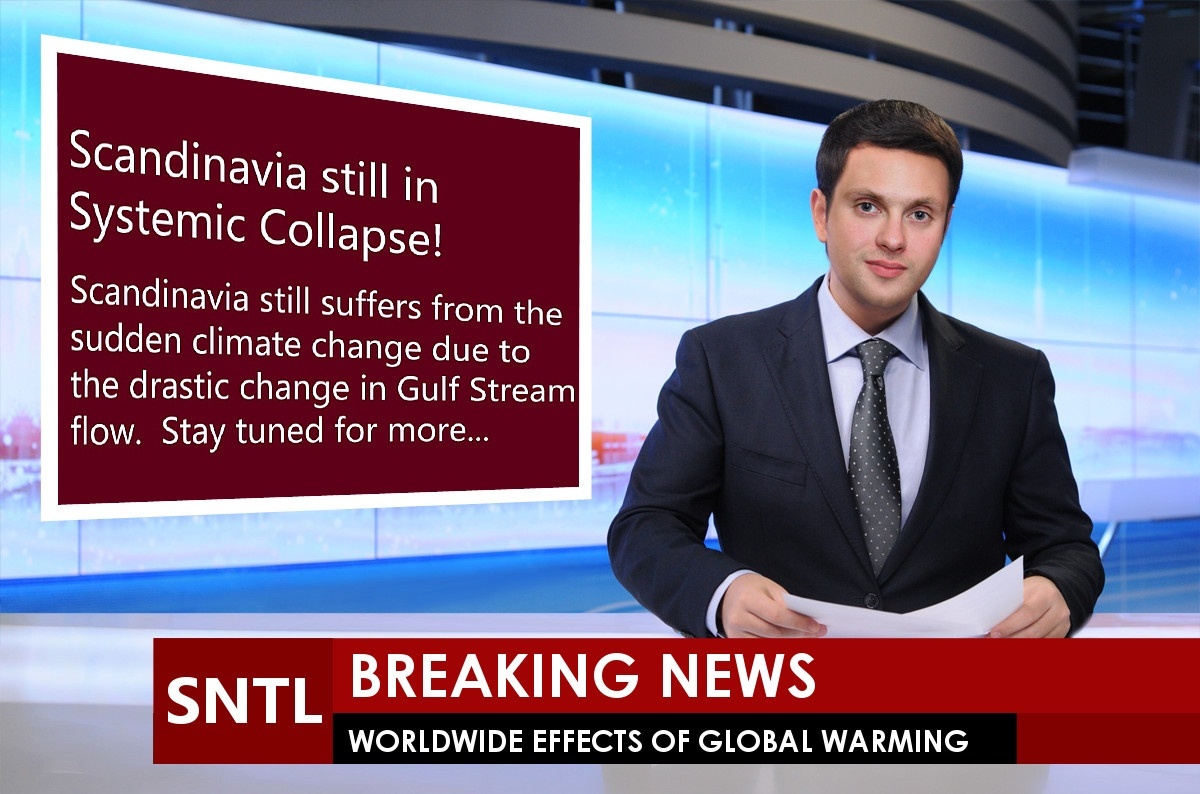
The southern part would still be habitable but unusable in terms of agriculture or farming. Most of the surface of Spain would be defined as "desert area". However, Northern Europe and Scandinavia are one of the few areas on Earth that would benefit from a continued global increase in the average temperature.

North America:
The northern part of Canada has the same conditions as Siberia regarding the melting of the permafrost. Large parts of the US "breadbasket states" would both be affected by such a drought that cultivation becomes impossible and be affected to an even greater extent by extreme weather such as tornadoes and massive hailstorms. The western US and California risk becoming almost uninhabitable and in the category of "desert area".

South America:
Due to the melting of the glaciers in the Andes, countries such as Peru and Bolivia risk becoming completely uninhabitable due to water shortages. This will (not maybe) begin in 10-20 years. If the global average temperature is around 3°C, which is guaranteed to happen if we reach 2°C and the permafrost in Siberia and Canada melts, it's goodbye to the Amazon. The Amazon will be wiped out.

Oceania:
Between 30-50% of all small (atoll) islands will cease to exist and must be evacuated. (This fate is shared with low land islands and atolls like the Maldives in the Indian Ocean). Australia, apart from the coastal areas, will essentially become uninhabitable in terms of a normally functioning society due to extreme heat and prolonged dry seasons making it a literal desert.
Then, with great certainty, a catastrophic increase in conflict zones and full-scale wars is predicted. China will be hit hard by famine and drought due to the melting of the Himalayan glaciers and the following effects on the Yangtze, Huang-Ho and Mekong deltas. China, which is largely held together by a strong and expansive economy, will very likely fall apart as the population will no longer tolerate the rigid and unfree social structure in the wake of an economic collapse. Africa, likewise, and which already has a series of small conflicts and outright wars, will likely be torn apart by further conflicts in the wake of famine in search of the few resources that will be available.
The USA, which is already strongly polarized today, also risks being hit by internal conflicts in the wake of a torn economy due to the collapse of agriculture and the loss of California as the economic engine that it has been until now.

Unfortunately, we do not think we will understand or wake up until this catastrophe jumps into our laps. We address our short-sightedness under PROPAGENDA in the menu above. And is all of this connected as a common thread with the somewhat unexpected empirical result of the
Drake Equation
?

SCIENCE - MUMBU JUMBO, CHEATING AND CONSPIRACY?


The above segment and the impact it can have on a reader is largely dependent on the extent to which one believes the content to be true – of course.

In a recent global survey, it was found that 1⁄3 of all people are skeptical of modern science and research. It gets even worse if you look specifically at climate research and Global Warming, where another survey shows that, for example, 42% of all Americans either do not believe in it at all or that Global Warming is a natural variation not caused by us humans.

However, when it comes to climate change and Global Warming, the contrast to what the research itself points to could not be more clear. Today (2021) 99.9% of all published scientific articles on Global Warming agree that we 1/ Are experiencing one and 2/ Humans are the cause. Read more here.

Stop here for a moment. The car mechanic, an expert on cars obviously, tells you that your engine is . "It will last another 1,000 miles at most". You look at the car, which is otherwise top-notch and looks like it can go as far as you want. So you jump in the car and continue up to your summer house in Montana/Scotland/Bretagne.. (or whereever), 1200 miles north. Or... do you really? You probably trust the mechanic.

But why don't we trust the scientific community, and in this case, the Science community?


Scientists strive for knowledge about nature and acquire that knowledge by investigating what they want to know more about. The methodology and the path to results that can be published and then, for the time being, accepted as accepted 'truths', are as follows:

A research group sets up hypotheses, collects data from the systems or phenomena they are investigating, analyzes these and then presents a result. The result is therefore a direct consequence of actually having observed the phenomena or phenomena that they want to know about.
Depending on what the phenomenon is, an incredibly important element in the analysis is a comparison with data that is due to chance. That is, the data that researchers obtain by measuring the phenomenon must be compared with data that is random.
Often, there is a so-called 'null hypothesis' (H0) when comparing the two data sets, i.e. data from measurements of the phenomenon and the data that they have carefully looked at are random. H0 is thus formulated as: "There is no difference between the two data sets". There are a number of statistical models that can then be used to analyze whether H0 should be rejected or accepted.

Since this site is aimed at everyone from the interface between high school and high school, we will take an example. If you can't bear to read the example, you can skip this.
We assume that H 0 states: "There is no difference in average temperature in Sweden during the year 1950 compared to the year 2020."
Reasonably, there should be more measurement data from 2020 than 1950, which is why we start by collecting as many places/municipalities as we can find from 1950, which have recorded temperatures and preferably from every day during the year and also spread throughout the day at different times. These are added and divided by the number of measurement data which then gives an average value for the given year and the given premises (for example, we could have chosen to only look at the temperature at 12:00 on the day or similar.)
In the same places/municipalities and on the same days and at the same times, we then note measurement data from 2020. These are also added and divided by the (same) number of measurement data and we get a corresponding annual average for 2020.
Even for this way of collecting data and analyzing, there are statistical models to use to see if the annual averages differ and also with what percentage they do not differ, H0 is the statement that they do not differ. This percentage regarding the correctness of H0 is called significance. A common threshold for rejecting H0 is 95% significance. If it is 'only' 94%, we have not been able to demonstrate any difference between the annual average temperatures in Sweden between the years 1950 and 2020.
Science is so stringent and hard, but it is of course so that we can trust the results that research points to, for everyone's sake. Also note that the design of our analysis of measured data did not have a comparison with random data and this depends in this case on the question and how we chose to do the analysis. If we had instead chosen, for example, to check whether the following H0 is true: "The author of this piece is no taller than the average (in Sweden)", we could have created a random sample of other Swedes by closing our eyes and randomly pointing to 1000 names (as large a number as possible) in a telephone directory and measuring their height and then comparing this with the author's...etc

When we discuss Global Warming, as we have already mentioned, it is just the short version of saying: "If we compare today's (year's) Global average temperatures with those that existed during pre-industrial times (average temperature 1850-1900), we today have a higher Global average. We call that difference - Global Warming".
One of the counterarguments to the fact that we have Global Warming was, as we mentioned earlier, the following: "- How can we talk about Global Warming today when in 2017, the lowest temperature ever in the history of the Earth was measured at a place in East Antarctica?".
Does a young reader agree when we say that it is the same thing as in the above example with the comparison between the annual average temperatures in Sweden during the years 1950 and 2020, picking out a temperature in Kiruna from January 10, 2020 and comparing it with the 1950 average temperature, and concluding that the average temperature in Sweden has decreased? Do we agree that the same mistake is being made?
Good, because anyone who draws such a conclusion does not understand the difference between Local (phenomena) and Global, nor what an (annual) average temperature means compared to a specific day's temperature.


To return to the scientific order from hypothesis to published results in a scientific journal (science journal).
When you feel satisfied with everything from the collection of data for your measured phenomenon through analysis to a final result, you present or send the result to usually 4-6, often competing, researchers who will review and critically examine everything from hypothesis via methods to results. Who these reviewing researchers are and how many there should be is ultimately up to the respective journal. If the other researchers find the slightest hole in any part of the entire chain, the research group must either redo those parts or come up with a stronger and clearer justification for why they did the right thing after all.
According to the editorial team's own experiences, it is often the statistics and comparative datasets that are criticized for lack of randomness or similar.
This procedure goes back and forth until everyone is satisfied and only then can the results be published in a journal. It absolutely happens that a result is refused to be published because the reviewing scientists simply consider the research to be substandard. This process of reviewing, competing, researchers within the same discipline is called "Peer review" and is a fundamental process in modern research to ensure that good and objectively correct results are published and at the same time that substandard and questionable research is filtered out.

Contrary to what many seem to believe, there are strong incentives for a researcher to come up with new hypotheses and results that are completely at odds with the current research. Or to put it differently, it is very much a case of showing that other researchers were wrong and that you yourself have figured out how things really are.
For a potential reader who is skeptical of Science and that there would be a hidden agenda with it, we can make an analogy for the self-cleaning process where old research is replaced with new, more accurate research: It's the same feeling you get when you get wind of hidden basements in Pizzerias in Washington that harbor pedophile networks, and which no one else has probably heard of and you will be the first to know! Exactly the same incentive and will exist for continuous better and more accurate research. Only one tiny difference, the Pizzeria story was made up by one of your friends.

Aside from the slightly sarcastic analogy, there is still a grain of truth in it. Why should researchers be different or less ambitious and ambitious than the average person? With that, there is also a self-cleaning and (per) definitional methodology of rejecting old and substandard or downright incorrect research.

But if a certain result holds up, despite other researchers' attempts to find holes in the entire chain of results, and that process thus rather reinforces and builds on the result - a hypothesis can be elevated to theory.
Many people use the word theory as if it were the lowest level on the results ladder, but in a scientific context it is the hypothesis. A hypothesis can, after repeated confirmed and confirmed results, then be elevated to theory.
Sometimes you hear or read about critical voices regarding Darwin's or Einstein's theories that - "Well, those are just theories, how do you know that they are really true?" or "That is just a theory, just like someone else's theory!" But then you should know that a theory is a result that has withstood lots of attempts to demonstrate errors in it and has also been confirmed over and over and over again, either explicitly by a series of other attempts to investigate the hypothesis or implicitly, meaning that you investigate other questions that cannot even lead to a hypothetical result if the original hypothesis is not correct.

Yet there are people who spend 10 minutes of reasoning and "common sense" and then reject the results and consequences of a theory that is both accepted and basic. Even results that may well be the result of decades of uninterrupted research by perhaps hundreds or probably thousands of researchers who individually and continuously contribute with partial results that are ultimately intended to make you, me, us or the world a little richer in knowledge and understanding. And that knowledge will of course be partial results and the basis for tomorrow's research and so on.


There are a huge number of forums and sites with an agenda to "fight the establishment" (as in media, science, politics, etc.). On these sites you can read about someone who looked out the window and saw a snowstorm and a thermometer showing a record low temperature and from the two locally and temporally isolated footprints of a "weather", conclude that global warming is a hoax.

"It snowed over 4 inches this past weekend in New York City. It is still October. So much for Global Warming."
Nov 1, 2012. Donald J. Trump.


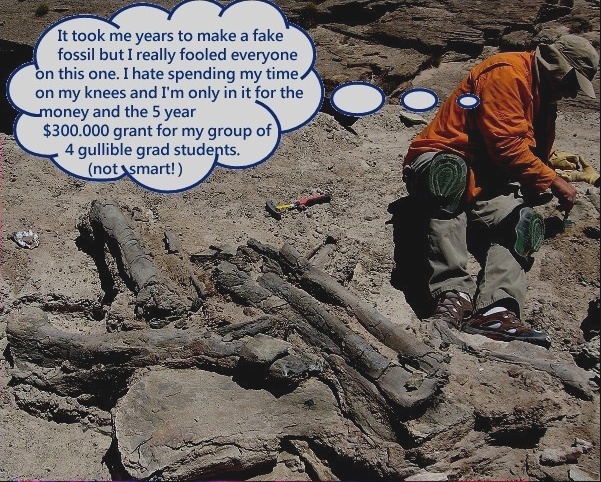
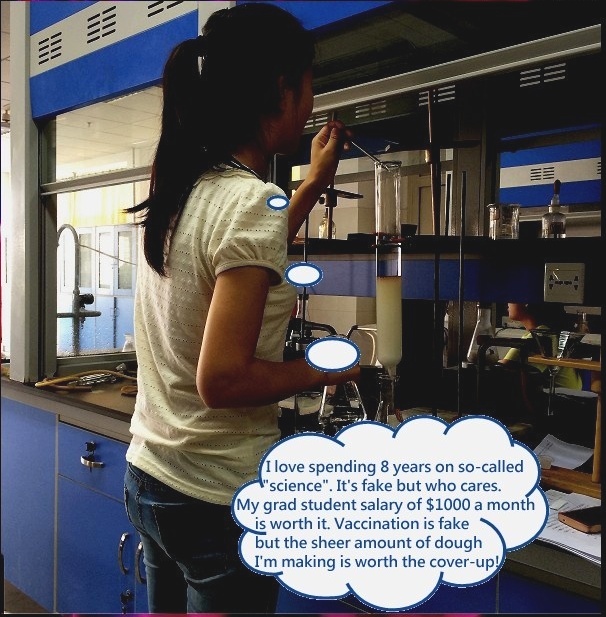
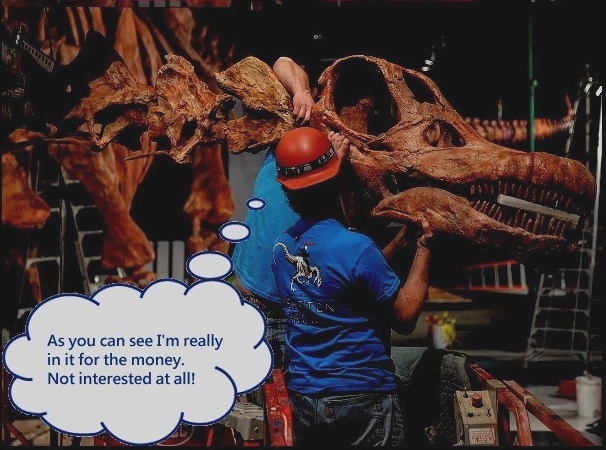
The idea that science or scientists are behind some kind of conspiracy agenda to mislead people is simply ridiculous. There are extremely few (I would say: read zero) scientists who are in their field for ideological or financial reasons. If anything, selfish in that case. You want to learn as much and as correct things as possible about something. If you do research for your own interest, there is a self-fulfilling incentive to not accept or publicly announce a result that you know is incorrect. It just doesn't happen. Point

Yes, 99% are probably nerds in the eyes of others. They always have the same clothes, crappy haircut, glasses, which they forget where they put them, plaid flannel shirts with an old coffee stain that refuses to disappear in the wash, possess limited social skills, drive a 20 year old Volvo... yes, the list can be made long but many of these 'prejudices' actually match up surprisingly well with actual attributes of these world domination conspirators. But they are fascinated by: nature, people, art, the universe, politics, economics, physics, climate, history, chemistry, etc., and ultimately just want to know as much about these subjects as possible. Do you seriously mean that these are part of a conspiratorial "establishment"?
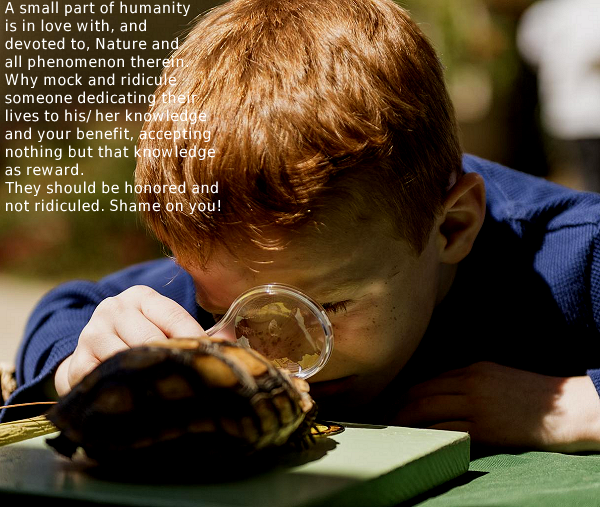
If there is anything negative in that context, it is probably rather the opposite. A researcher doesn't really care that much about you or me. As long as you are left alone in your room and gather your knowledge, you don't really care how much of what you and I understand or how much it benefits us.


There are quite a few controversial areas, perceptions or phenomena where researchers are accused of being biased and prejudiced in their explanations of these phenomena. This without the researcher even considering that such a thing could be true, per se. Examples of such areas could be everything from paranormal phenomena to mind reading, telepathy, impact windows or UFOs. And that is probably true today in 2010. It would take a lot for a serious researcher today to apply for funding to investigate whether a dowsing rod* work, for example.
BUT, there is certainly not a researcher who would not be completely happy if it turned out that there is substance and truth in any or all of these. What a fantastic discovery that would be! And it would definitely give the researcher a publication in one of the major journals such as Science Magazine™ or Nature™. That is why the word 'today' was used. There have been serious researchers who have investigated such phenomena and despite the fact that science is accused of ignoring these phenomena, today these are rejected with good reason as they have repeatedly been proven to be false.
* From Google translate: tige de radiesthésie, Wünschelrute, 探矿棒 ( 探礦棒 ), varilla de radiestesia.


In that sense, researchers are just like everyone else in their ambition. If there is any driving force besides the purely self-enlightening calling, it is precisely to be published in journals such as Science or Nature. It is the second most prestigious prize you can experience after the Nobel Prize. Here you are guaranteed not to get published by breaking open some open doors or by latching onto some research trend that consolidates or strengthens existing knowledge. Here, innovative and revolutionary research is rewarded and as a researcher you are almost guaranteed a continued research career and lifelong funding for this career if you manage to get an accepted article in these journals.

Keep that in mind when you distrust the scientific community for following someone's lead or for being part of a conspiracy and hide behind the popular "they" (when pointing to the research comunity who decive us all).


Since, for example, the "sweeping box" theory would certainly find a place in Science or Nature, IF the results show that it is correct, how do you go about it? (or how did you go about it?)
There is nothing that says that you cannot find water with a sipping box. You can. Even the scientific community agrees with this. And it can of course be tested. Here too, you can skip this section.

Take two people, one with a dowsing rod (see above for translations), who also considers himself to have the expertise, and another person who should be randomly selected and does not possess any knowledge that would make the person not randomly good, or not randomly bad, at finding water even without a sipping box. Either both are blindfolded or neither, or you just blindfold the person who should not have any prior knowledge of sipping box techniques. You probably choose several, for the purpose, suitable places in nature where both of them should mark where there is water (vein). You also have to define what counts as "finding water". Anyone who has drilled a well, or if it is considered common knowledge, knows that if you drill deep enough, you will find water pretty much everywhere. It is called groundwater.
The hypothesis that you can find water with a punch box more reliably than random attempts, now takes effect and to the researcher's surprise, the punch box guy succeeds on the first try. They try again and the punch box succeeds once again. As a researcher, you start to get a little excited and see that article in Science Magazine™ in front of you... So the researcher tells them to repeat the experiment again, and again...and again, etc. The next 3 times both succeed and after a total of one hundred repetitions of the experiment and to the researcher's great chagrin, the result is: The punch box 82 successful attempts and the blindfolded one 81.

This type of experimental setup is one of the foundations of research, so-called repetitive experiments. And with that said, it is of course necessary to repeat both within the experiment (here 100 times) but also to repeat the experiment itself, by other research groups, other participants, another impact square, another location, etc.
And yes, many more such experiments have been done, and yes, in fact, even one that proved the impact square technique correct, but that experiment failed to pass the "peer review" process mentioned above. And yes, once again, no experiment led to a result where it could be shown that water could be found with more certainty than just chance. For those interested, reference can be made to one of the most famous of these experiments here.


Hopefully, "common sense" here can also realize that it is not a 50/50 chance of finding water. Water generally seems to be quite easy to find, which is probably also why the impact window theory is so tenacious and viable despite it being proven to be a false expertise. Even by chance you can find water 8 out of 10 times and since the impact window technique also managed to find water 8 out of 10 times, you cannot distinguish any expertise in using impact windows from the purely random outcome.

A short story long

The point is, why don't people in generall listen when people in particular tell us that we're up to our knees in troubles? Listen please...when the scientific community says that the way we live today is a dead end and it's only the degree of disaster we can still influence, it's not said as guesswork or comes from "common sense". It's because 8 hours, 5 days a week, 48 weeks a year and 50 years of interest, dedication and analysis tells us precisely that, essentiell.org hopes that's clear and distinct. It's absurd, mindboggling and, sorry to say, really stupid to say otherwise.


Contact

SEND US A MESSAGE IF YOU HAVE ANY QUESTIONS.
info@essentiell.org

RESPONSIBLE PUBLISHER AND SCIENTIFIC EDITOR IS MATS ENSTERÖ, Ph.D.
SEND EMAIL TO mats.enstero@essentiell.org